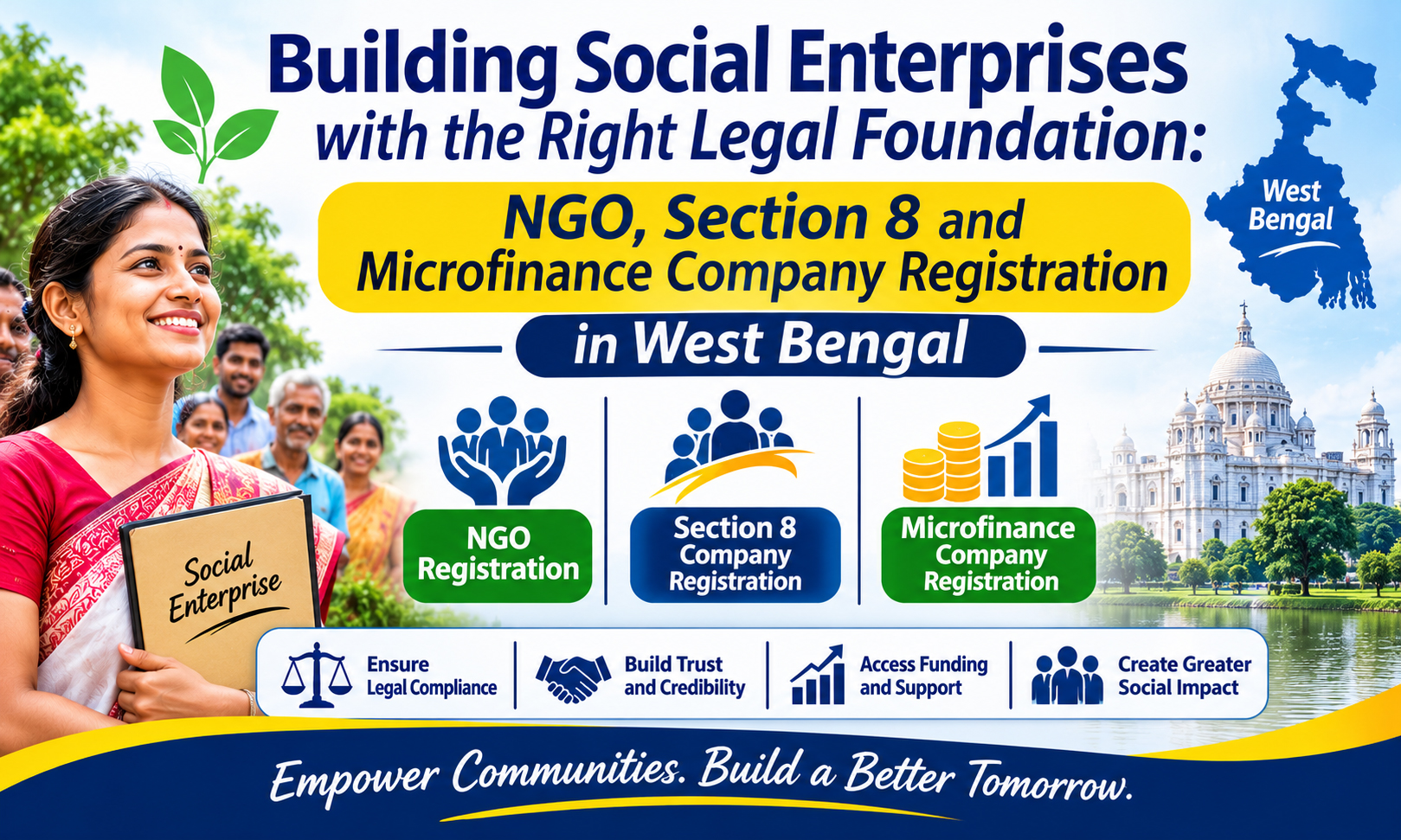
Starting a non-profit organisation or social enterprise is a meaningful step towards creating positive changes in society. Whether the objective is to support education, improve healthcare, empower women, promote rural development, or provide financial assistance to underserved communities, establishing a legally recognised organisation is essential for long-term growth.
In India, individuals and groups can establish different types of organisations depending on their objectives, activities, funding requirements, and management structure. Section 8 Companies, Non-Governmental Organisations (NGOs), trusts, and societies are some of the commonly used organisational structures for social welfare activities.
West Bengal has many opportunities for social entrepreneurship and community development. However, choosing the appropriate legal structure and completing the required registration formalities can be challenging without proper guidance.
Webbsky Technology provides digital solutions and professional support related to organisational websites, software, and registration-oriented services. Understanding the registration process is the first step towards building a legally structured and sustainable organisation.
Understanding Section 8 Company Registration
A Section 8 Company is a special type of company established under Section 8 of the Companies Act, 2013. It is formed to promote charitable objectives such as education, science, sports, social welfare, environmental protection, research, and other activities beneficial to society.
Unlike ordinary commercial companies, a Section 8 Company must apply its profits and income towards promoting its objectives. It cannot distribute dividends to its members.
Key Benefits of a Section 8 Company
Legal Recognition : Provides a formal corporate identity under Indian company law.
Limited Liability : Members generally receive protection from personal liability, subject to applicable legal provisions.
Structured Management : Offers a defined management framework through directors and governing documents.
Credibility : Can help establish trust among donors, institutions, beneficiaries, and other stakeholders.
Social Impact : Allows organisations to pursue charitable and non-profit objectives through a recognised legal structure.
Basic Registration Requirements
The registration process generally involves :
1. Selecting a suitable and legally available company name.
2. Identifying the proposed directors and members.
3. Preparing the Memorandum of Association (MOA) and Articles of Association (AOA).
4. Obtaining applicable digital signatures and identification documents.
5. Filing the prescribed incorporation application with the Ministry of Corporate Affairs (MCA).
6. Completing the applicable regulatory formalities and obtaining the Certificate of Incorporation.
Organisations planning Section 8 Company Registration in West Bengal should carefully define their charitable objectives and prepare the necessary documentation before beginning the incorporation process.
Section 8 Company Registration in Kolkata: Important Things to Know
Kolkata is an important centre for educational institutions, charitable initiatives, healthcare organisations, and social development activities. Individuals planning to establish a non-profit company in the city should understand the legal and administrative requirements.
Section 8 Company Registration in Kolkata involves preparing the company's proposed objectives, identifying directors, selecting a name, and submitting the necessary incorporation documents through the MCA process.
Documents Generally Required
PAN and identity proof of proposed directors.
Address proof of directors and subscribers.
Recent photographs, where required.
Registered office address proof.
Utility bill for the registered office, as applicable.
No-objection certificate from the property owner, where required.
Proposed MOA and AOA.
Other declarations and documents prescribed by the MCA.
Proper documentation helps reduce errors and delays during the incorporation process.
Understanding NGO Registration in West Bengal
A Non-Governmental Organisation is generally established to work towards social, charitable, educational, environmental, or community development objectives.
In India, an NGO is not a single legal registration category. Depending on its objectives and structure, an organisation may be established as :
A public charitable trust.
A society under the applicable Societies Registration law.
A Section 8 Company under the Companies Act, 2013.
Each structure has different legal requirements, governance rules, and compliance responsibilities.
Benefits of Registering an NGO
Establishes a recognised legal structure.
Helps build credibility among donors and beneficiaries.
Provides an organised framework for managing social projects.
Supports formal agreements and institutional partnerships.
Creates opportunities to apply for eligible grants and funding.
Helps maintain transparency and accountability.
For organisations planning NGO Registration in West Bengal, selecting the appropriate legal structure is an important decision. The choice should depend on the organisation's activities, number of founders, governance preferences, and long-term plans.
NGO Registration in Kolkata: Step-by-Step Approach
Kolkata has a strong network of social organisations working in education, healthcare, child welfare, women's empowerment, and rural development.
Before starting NGO Registration in Kolkata, founders should determine the organisation's primary objectives and select an appropriate legal structure.
Recommended Steps
Define the Mission : Identify the social cause and objectives of the organisation.
Choose the Legal Structure : Decide whether a trust, society, or Section 8 Company is appropriate.
Select the Name : Choose a suitable name that complies with the relevant legal requirements.
Prepare Documents : Collect identity proofs, address proofs, governing documents, and other required papers.
Submit the Application : File the relevant application with the appropriate registration authority.
Complete Formalities : Respond to any queries and fulfil additional requirements.
Maintain Compliance : Keep proper accounts, records, meeting documents, and statutory filings.
Microfinance Company Registration in West Bengal
Microfinance organisations provide financial services to individuals and communities that may have limited access to conventional banking facilities. These services can include small loans and other permitted financial products designed to support low-income households, self-employed individuals, and small entrepreneurs.
However, starting a microfinance business requires careful consideration of the applicable regulatory framework.
Microfinance Company Registration in West Bengal depends on the proposed business model and legal structure. For example, a company intending to conduct lending activities may need to consider the applicable Reserve Bank of India (RBI) requirements, including Non-Banking Financial Company (NBFC) regulations where relevant.
Important Considerations Before Starting
Decide the proposed business and lending model.
Select an appropriate legal structure.
Understand the applicable RBI registration and regulatory requirements.
Evaluate minimum capital and other eligibility conditions.
Prepare the required business plan and financial projections.
Establish proper accounting and loan management systems.
Understand customer protection and applicable lending rules.
Arrange professional legal and financial guidance.
It is important to note that incorporating a company does not automatically authorise it to conduct regulated lending activities. The required permissions and regulatory conditions must be fulfilled before commencing business.
Why Proper Documentation and Compliance Matter
Registration is only the beginning of an organisation's legal journey. Maintaining compliance is equally important for long-term sustainability.
Some important responsibilities include :
Maintaining accurate financial accounts.
Filing applicable annual returns and financial statements.
Holding required meetings and maintaining minutes.
Updating statutory records.
Following applicable tax and regulatory requirements.
Maintaining transparency in donations and project expenditure.
Obtaining additional registrations or approvals wherever eligible and necessary.
For example, eligible charitable organisations may separately explore registrations under applicable income tax provisions, such as 12AB and 80G. These are not automatic benefits of incorporation and require separate eligibility and approval processes.
How Webbsky Technology Can Support Your Digital Journey
After establishing an organisation, having a professional website and suitable management software can help improve its visibility and operational efficiency.
Webbsky Technology provides digital technology solutions for organisations looking to establish and strengthen their online presence.
Important digital solutions for NGOs and financial organisations include :
Professional Website Development : Create an informative website showcasing the organisation's mission, objectives, and activities.
NGO Website Development : Display projects, achievements, donation information, and volunteer opportunities.
Microfinance Software : Manage customer records, loan accounts, repayments, and financial reports.
Co-operative Society Software : Simplify membership management, accounting, deposits, and loan operations.
Customised Software Development : Develop digital solutions according to specific organisational requirements.
A professional website also helps organisations communicate with donors, beneficiaries, business partners, and other stakeholders.
Frequently Asked Questions (FAQs)
✔ Q1. What is a Section 8 Company in India?
A Section 8 Company is a non-profit company established under the Companies Act, 2013, to promote charitable and other specified objectives. Its income must be applied towards its objectives, and dividends cannot be distributed to members. <Cite refs={["turn319811search0"]}/>
✔ Q2. What is the difference between an NGO and a Section 8 Company?
An NGO is a broad term for a non-governmental organisation. It may be registered as a trust, society, or Section 8 Company, depending on its objectives and legal requirements.
✔ Q3. Can an NGO receive donations after registration?
Yes. An NGO can receive donations subject to applicable laws and compliance requirements. Separate tax registrations or approvals may be necessary for particular tax benefits.
✔ Q4. What documents are generally required for NGO registration?
Common documents include identity proofs, address proofs, proposed organisational objectives, governing documents, and details of founders or trustees. Exact requirements depend on the selected legal structure.
✔ Q5. Is Section 8 Company registration suitable for charitable organisations?
Yes. It can be suitable for organisations promoting education, healthcare, social welfare, research, environmental protection, and other eligible charitable objectives.
✔ Q6. What is required to start a microfinance company?
The requirements depend on the proposed business model. Organisations conducting regulated NBFC activities must examine applicable RBI registration, capital, and compliance requirements before starting operations. <Cite refs={["turn319811search4","turn319811search6"]}/>
✔ Q7. Can a Section 8 Company automatically conduct microfinance activities?
No. Section 8 incorporation does not automatically authorise regulated lending activities. The proposed objects and applicable MCA and RBI requirements must be examined carefully. <Cite refs={["turn319811search9","turn319811search10"]}/>
Conclusion
Establishing a legally recognised organisation is the foundation of successful social and financial development initiatives. Whether you want to establish a charitable organisation, promote educational activities, support community welfare, or develop a financial services business, choosing the correct legal structure is essential.
From selecting the appropriate registration category to preparing documents and understanding compliance responsibilities, every step requires careful planning.
Webbsky Technology aims to support organisations through digital solutions, website development, and software services that help them build a stronger professional presence.
If you are planning to establish an NGO, Section 8 Company, or microfinance-related organisation in West Bengal, take the first step towards building a structured and digitally empowered organisation.